When we talk about municipal independence for the Pacífico Sur of Baja California Sur, a lot of people think: "We just need to collect signatures, right?"
If only it were that simple.
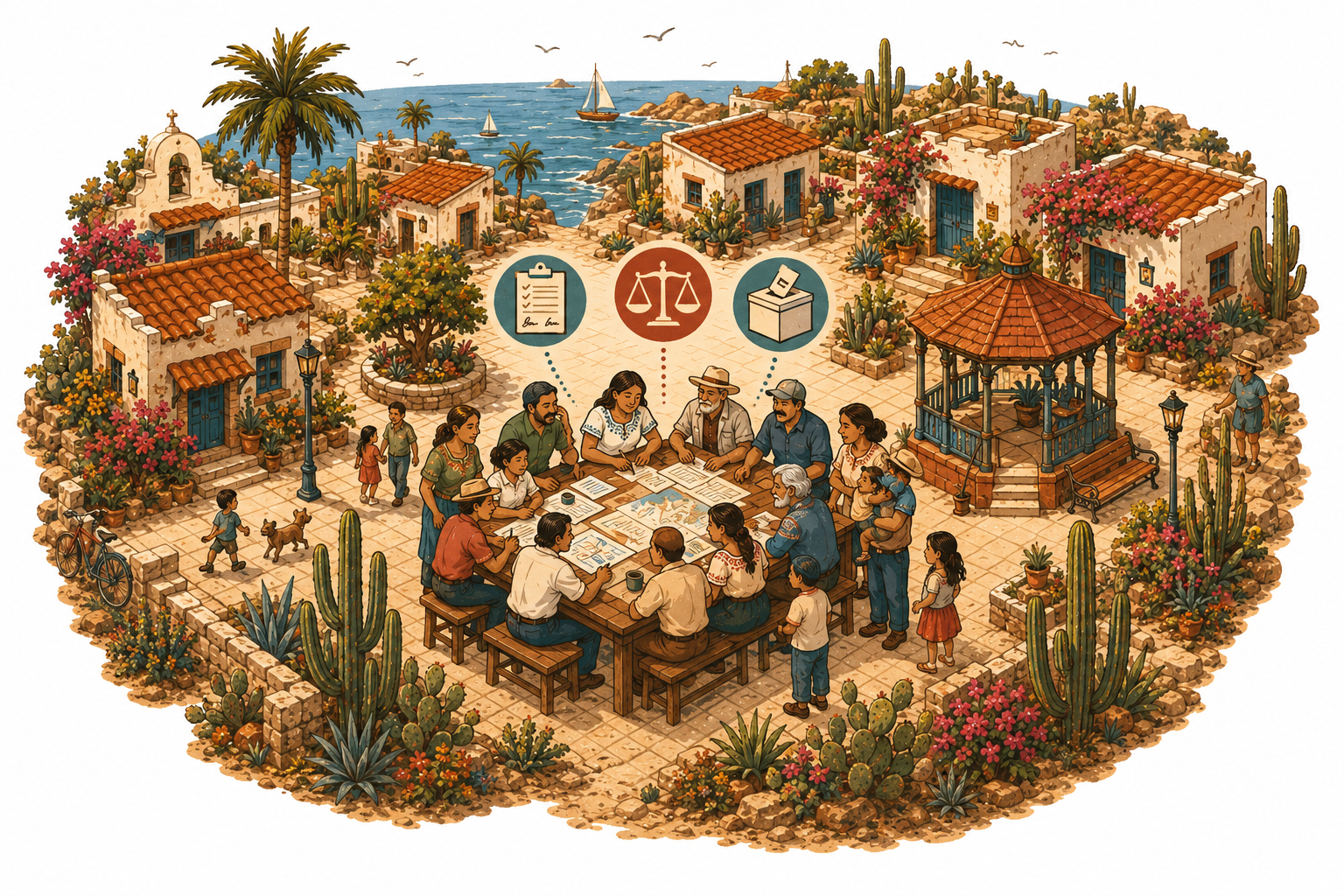
Creating a new municipality is not a petition. It's a campaign — with three phases, strict legal requirements, and a minimum timeline of about 20 months, when everything goes well. Here's the real process, in plain language, so everyone in the community understands what we're asking for and what it takes to get there.
Phase 1: Building the foundation (~2 months)
Before asking the State Congress to recognize a new municipality, the law requires us to prove three things:
That real citizen will exists. It's not enough to say it — we have to demonstrate it with a serious public opinion study, hundreds of interviews across the communities.
That the territory is viable. That means a technical cartographic study: boundaries, population, roads, hydrology, economy, productive vocation, electoral sections. Article 122 of the State Constitution requires sufficient territory, a minimum of 5,000 inhabitants in the territory, a county seat of at least 3,000, and adequate public services.
That an organized citizen body exists. This is the Comité Promotor — with legal counsel from day one.
Without this foundation, nothing else moves forward.
Phase 2: The citizen petition and plebiscite (~6 months)
This is where the signatures come in — but not how most people imagine.
The law requires 33% of the electoral roll (padrón electoral) of the territory that wants to become a municipality. Not 33% of the residents. 33% of registered voters. In our case, that's several thousand signatures, not a few hundred.
And each signature has to include:
- Full name
- Signature
- Voter ID number (the one on the INE credential)
Each signature gets verified against the electoral roll. If a person doesn't appear, or the data doesn't match, that signature is thrown out. Political opponents will challenge them — that's a normal part of the process. That's why informal signature collection, without clear legal protocols, typically loses 20-30% of signatures in verification. If we barely reach 33%, we lose.
Once delivered and validated, the electoral authority calls a plebiscite. For it to pass, at least two-thirds of votes cast have to be "yes" (Article 122, fraction VIII). That requires a serious information campaign, media presence, bilingual materials, and a structure to mobilize voters on election day.
Phase 3: Legislative approval and transition (~12 months)
If the plebiscite passes, the proposal goes to the State Congress, which requires a two-thirds vote of deputies (Article 64, fraction XXXV).
But before that we have to:
- Negotiate with the municipality we're separating from (La Paz, in our case): which assets, infrastructure, and personnel transfer to the new municipality.
- Deliver a Municipal Development Plan and an Urban Development Plan showing the new municipality can govern itself and grow sustainably.
- Lobby seriously with legislators, their teams, and other relevant political actors.
San Felipe, in Baja California, completed this process in just 13 months once political conditions aligned. That speed wasn't luck — it was the result of having people who knew exactly what to do, when, and who to talk to.
Read the full San Felipe case study to see how a community 30 years in the making moved from delegation to municipality in just over a year once the political moment arrived. Read the San Felipe case study →
Why we need a professional team AND the community
This is the important part: no professional team can replace community energy. And no amount of volunteer enthusiasm can replace the legal precision the law demands.
The professional team handles:
- Legal strategy and documentation that survives challenge.
- Coordination with the electoral authority, the Congress, and the current municipality.
- Lobbying and reading the political moment.
- The technical studies required by the Constitution.
The community handles:
- Spreading the proposal door to door, in plazas, in businesses.
- Identifying who would support signing and who wouldn't.
- Organizing events, gatherings, conversations.
- Mobilizing the vote on plebiscite day.
When these two sides work together, costs come down, speed goes up, and the proposal becomes unstoppable. When one tries alone, it usually fails.
What's next
Starting next week, the community will have the opportunity to meet directly with the first team of professionals we're considering to guide and carry out this process. More may follow in the coming weeks. This is part of a broader evaluation — a chance for all of us to get to know each team, ask the hard questions, and together decide who is best suited to carry this forward.
The invitation is open to anyone who wants to listen, ask questions, and participate.
We're not signing a paper. We're building a municipality. And that requires all of us to understand what we're doing.