
Our community's growth is inevitable. More people are coming, more projects, more demand for everything — but especially for water. Our job as a community isn't to stop that growth, but to make sure it happens consciously and intentionally, protecting the environment our future depends on.
To do that, we need to understand how our resources are managed. And the most urgent resource is water.
The Todos Santos aquifer — our only source of fresh water — is currently being extracted at nearly double the rate nature can replenish it. According to CONAGUA data, 6.6 million cubic meters were extracted in 2023 against a recharge of just 3.7 million. The natural boundary between fresh groundwater and ocean saltwater has shifted inland to 1.6 kilometers from the coast, according to Colorado State University researchers — a clear signal that the aquifer is losing pressure. And 2024 was the driest year of the century in Baja California Sur.
Why is the saltwater advancing?
To understand desalination, you first need to understand what's happening beneath our feet.
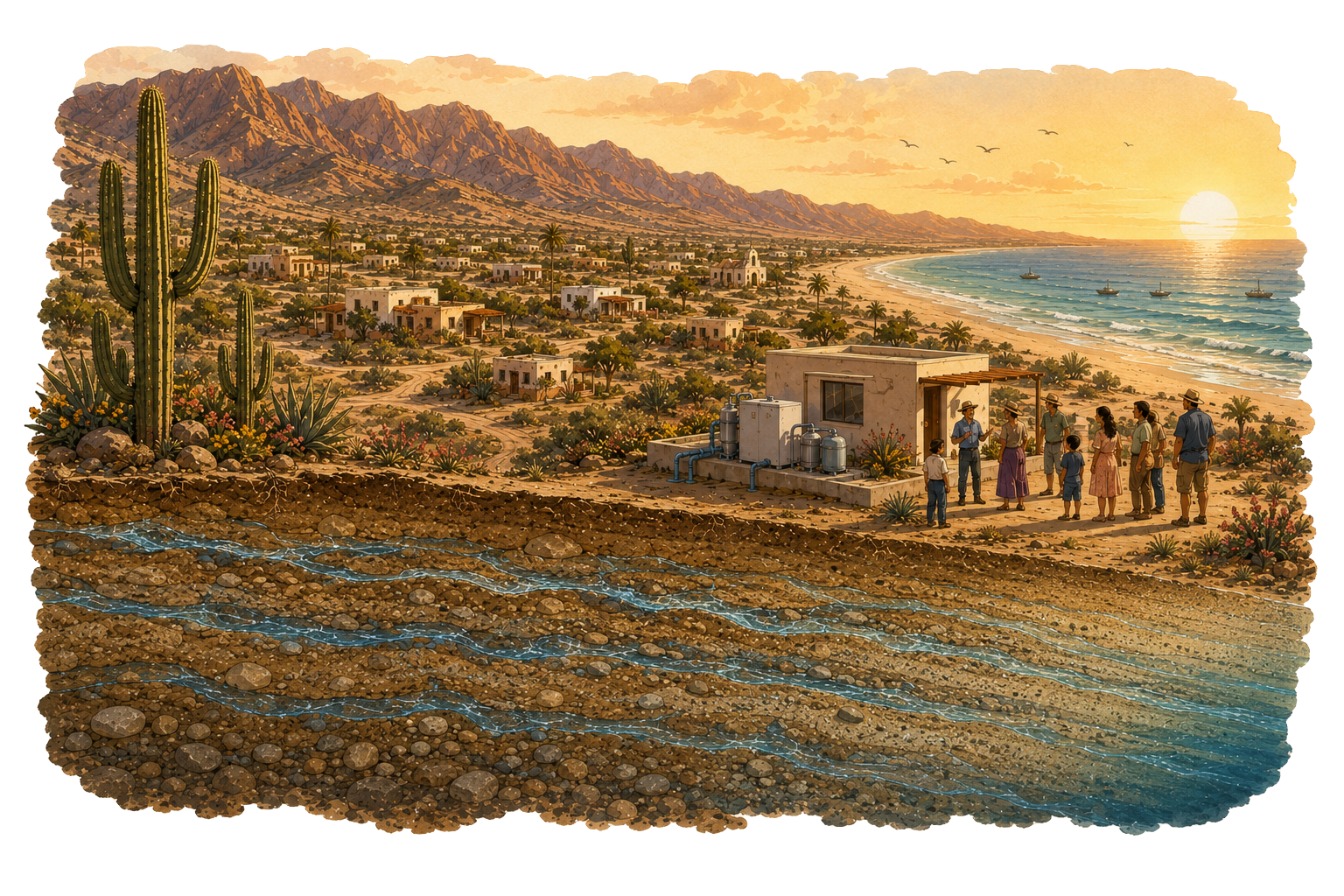
Imagine an underground tug of war. On one side, fresh water from the aquifer pushes toward the coast. On the other, ocean saltwater pushes inland. When the aquifer is healthy and full, the fresh water wins — it pushes the boundary close to the coast and even discharges fresh water into the ocean through the seafloor.
But when more water is extracted than is replenished — as is happening here — the fresh water loses pressure. The boundary shifts inland. That's what the CSU researchers measured: the point where salt concentrations in well samples exceeded the drinking water threshold had moved to 1.6 kilometers from the coast by 2017. It's not a river of saltwater traveling underground for a mile. It's the entire equilibrium shifting because we're extracting faster than nature recharges.
The cause of that shift isn't something happening at the coast — it's the agricultural and municipal wells extracting fresh water kilometers inland, reducing the pressure that keeps the saltwater in place. This is crucial for evaluating any coastal activity, including desalination.
With that as context, we wanted to better understand desalination. We know it's a topic that generates skepticism in the community — and that skepticism is well-founded. Early desalination plants worldwide discharged brine directly into the sea, harming marine life. In communities like ours, water infrastructure promises haven't always been kept. It's natural to be cautious.
But technology evolves, and we wanted to see for ourselves whether modern desalination is genuinely different. Is it a viable option for future developers — or even for the community? Can it be done without harming the environment? What are the real risks?
We visited Hotel San Cristóbal's desalination and water treatment plant to look for answers. Here's what we learned — and what we verified on our own.
How does it work?
The system uses reverse osmosis — the most widely used desalination technology in the world.
Brackish water (water that contains some salt — more than fresh water but less than seawater) is extracted from the subsoil through a coastal well about 50 meters from the ocean, based on satellite measurement. No water is taken directly from the sea — the soil acts as a natural filter and avoids trapping marine organisms.
That water passes through sand and activated carbon filters, then high-pressure pumps push it through semi-permeable membranes that let water through but hold back salt.
For every 100 liters that enter, 40 become drinking water with less than 0.5 parts per thousand total dissolved solids. The other 60 liters are the brine — the concentrate that remains. That 40% yield is the industry standard for this type of system.
The system operates under a CONAGUA concession, with ultrasonic meters reporting directly to the regulator and certified laboratory analyses going straight to CONAGUA without passing through the operator. These official audits are conducted every three months by a third-party laboratory, with additional internal audits monthly. The concession limits extraction to 80,000 cubic meters annually; they currently use approximately 60%.
The key question: what happens to the brine?
This was our first question, and it's the right one. The greatest environmental risk from desalination has always been in how the brine is managed.
The brine doesn't go into the sea. It goes into a 70-meter-deep reinjection well, also located about 50 meters from the coast. From there it disperses through the subsoil sand layers.
Can this affect the freshwater aquifer?
We researched independently, and the short answer is: not in this case — and the reason connects directly to that underground tug of war we explained above.
Remember: the boundary between fresh and salty water sits 1.6 kilometers from the coast. The system's wells — both extraction and injection — are about 50 meters from the ocean. That places them more than a kilometer and a half on the seaward side of that boundary, in a zone where the groundwater is already salty.
The most direct proof is the system itself: if there weren't saltwater in the soil at that depth and distance from the ocean, they couldn't extract brackish water to desalinate. The brine is reinjected into ground that is already saline.
An important clarification: that 1.6 kilometers comes from a study conducted by Colorado State University (CSU), and represents a general measurement across the aquifer. But the boundary between fresh and salty water isn't a straight line along the entire coast — it varies by location. Near arroyos, where freshwater flows more forcefully toward the sea, fresh water can be as close as a couple hundred meters from the ocean. In flat, sandy areas without an arroyo feeding the flow, saltwater dominates further inland. This is precisely why any desalination project must include a site-specific hydrogeological study — because what is safe at one point along the coast may not be at another.
But doesn't the brine push that boundary further inland?
At this scale, no. What pushes the saltwater boundary inland isn't additional salinity at the coast — it's the loss of pressure in the freshwater aquifer kilometers inland. It's the extraction of 6.6 million cubic meters annually against a recharge of 3.7 million that shifts that equilibrium. It's the agricultural and municipal wells that reduce the pressure holding the saltwater back.
At maximum capacity, the system rejects 133 cubic meters daily. Against the volume of ocean water naturally cycling through that strip of sand between the highway and the surf — a volume that renews completely with every tidal cycle and current — those 133 cubic meters don't alter the pressure equilibrium that controls the boundary's position.
Research published in Hydrogeology Journal (2026) supports this logic: when brackish water is pumped at the same time brine is injected — exactly what a two-well system like this one does — the extraction counteracts the injection's effect, keeping the boundary stable. The studies that do document serious impacts were modeled at injection volumes a hundred times larger than this system.
A technical point worth understanding: at 40% recovery, the reverse osmosis process concentrates salts approximately 1.67 times relative to the input water. In other words, the brine is a saline concentrate — that's inherent to the process. But what determines the environmental impact isn't how salty the brine is, but where it goes. In this case, it goes to a point already saturated with saltwater, more than a kilometer and a half from the nearest fresh water, in a volume that's negligible against the natural ocean-groundwater exchange in that coastal zone.
The caution that does matter
The boundary between fresh and salty water isn't fixed — it's been shifting inland as the aquifer is overexploited. What is a safe injection zone today could stop being one if overextraction continues unchecked and that boundary keeps advancing toward the coast.
That's why continuous monitoring of that boundary's position isn't optional — it's the most important indicator of whether a system like this continues to operate responsibly. And it's why the real risk to our water isn't a well-sited coastal desalination plant — it's the uncontrolled extraction of the aquifer inland.
Wastewater treatment
The other half of the system we saw deserves its own attention.
The process works in multiple biological phases: anaerobic bacteria break down organic matter without oxygen; then, in tanks with aerators running 24 hours a day, aerobic bacteria convert the remaining compounds into carbon dioxide and water. The result passes through clarification tanks and finally to storage. The treated water meets Mexican standard NOM-003 for green-area irrigation, and the volume reused for irrigation is equivalent to roughly 360 water truck loads per year — water that would otherwise have to come from the aquifer.
According to what we were told during the visit, the municipal treatment plant in Todos Santos does treat wastewater, but that treated water is largely not reused. Across the area, virtually nobody recycles treated water — everyone irrigates with drinking water, even for gardens. If that's true, it's a waste that we as a community should be discussing.
How much does it cost?
From what we were able to learn, a system at a similar scale requires an initial investment of approximately 3 million pesos for the well and 6 to 8 million pesos for the desalination plant. Monthly operation — electricity for both plants — runs between 70,000 and 80,000 pesos. That energy currently comes from CFE; solar panel installation is already being evaluated.
We wanted to understand the real cost per cubic meter of water produced and compare it to what we pay today. Using the data from the visit, we did the math:
The system we visited currently produces roughly 16,800 cubic meters of drinking water per year. Considering only electricity, that works out to about 54 pesos per cubic meter. Including full amortization of the entire initial investment over 15 years plus maintenance costs, the price rises to about 99 pesos per cubic meter at current production — and drops to roughly 73 pesos per cubic meter if the system operates at its full authorized capacity.
For context: water from a truck in Todos Santos costs around 140 pesos per cubic meter. In other words, even counting the cost of building the entire plant, desalinated water comes out 30 to 50 percent cheaper than buying it by truck. And in a region with sunshine virtually year-round, the question of how to reduce that energy cost has an obvious answer we'll explore later in this series.
What this means for our community
We're not proposing that desalination is the single solution. The aquifer needs active protection: reducing overextraction, improving distribution infrastructure, and promoting responsible use.
Nor are we endorsing any particular project. We went to learn, we asked questions, we took notes, and afterward we independently researched what we were told. We're sharing all of that here.
After seeing the system, researching the science, and verifying the data, here's what we concluded:
Desalination, done this way, works. When the wells are on the seaward side of the freshwater boundary, when the brine goes into the subsoil rather than the ocean, when extraction and injection operate together in the saline zone, and when everything is regulated by CONAGUA with verifiable monitoring — the environmental risks that legitimately worried people are controlled.
That doesn't mean any desalination is safe. A poorly sited plant, without monitoring, with direct ocean discharge or near the freshwater aquifer, can cause real harm. The studies documenting negative impacts are about those kinds of operations. Understanding the difference matters.
The biggest risk to our water isn't coastal desalination — it's aquifer overextraction. That's what pushes the saltwater boundary inland, contaminates wells, and threatens our freshwater supply. A well-sited coastal desalination plant doesn't move that boundary. The 6.6 million cubic meters we pull from the aquifer every year does. The question we should be asking isn't just whether new developments can avoid harming the aquifer — it's whether they can help restore it.
As a community, we now have a framework to demand accountability. Any desalination plant in our area should meet, at minimum:
- A formal CONAGUA concession with verifiable monitoring
- Injection wells located on the seaward side of the freshwater-saltwater interface, confirmed by an independent hydrogeological study
- Ongoing monitoring of that interface's position over time
- A two-well system in the saline zone (simultaneous extraction and injection)
- Treatment and reuse of wastewater
Our community's skepticism about water promises is well-founded. That's why we did this exercise: to understand the technology well enough to tell the difference between a project that delivers and one that only promises.
Water is our most valuable resource and our most urgent problem. Understanding what's possible lets us demand what's necessary.
This article is the first in a series on sustainable solutions for our community. In the next installment, we'll explore what measures can be taken to improve the situation facing our aquifers.